
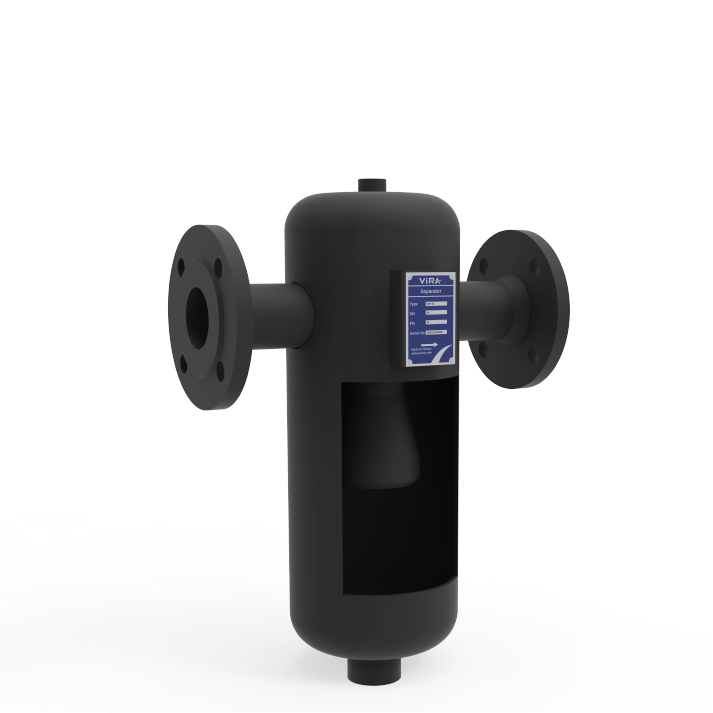
Detail
VIRA Cyclone-Type Steam & Compressed Air Separators are designed to remove entrained moisture, condensate and liquid particles from industrial steam and compressed air lines. Their internal design creates a controlled rotational flow that uses centrifugal force to separate heavier liquid droplets from the main flow.
Inlet Guide Plate and Internal Conical Element
At the separator inlet, a guide plate directs the incoming steam or compressed air into a controlled rotational movement. The internal conical element strengthens this vortex effect and increases centrifugal force within the separator body. This helps move heavier water droplets and liquid particles away from the main flow and toward the inner wall.
Cyclone Separation Principle
As the flow rotates inside the separator, centrifugal force drives the separated liquid droplets to the internal wall. The droplets lose velocity, coalesce and move downward under gravity to the lower section of the separator. The collected condensate is discharged through the condensate outlet, while drier steam or cleaner compressed air continues through the pipeline.
Improved Steam Dryness and Heat Transfer
Steam dryness is essential for efficient heat transfer and stable process operation. Wet steam can reduce thermal efficiency and contribute to water hammer, corrosion, erosion and irregular operation. VIRA cyclone steam separators help reduce moisture carryover before steam reaches heat exchangers, control valves, process equipment and other steam-consuming applications.
Cleaner Compressed Air for Pneumatic Systems
Compressed air can form condensate as it cools in pipelines. Liquid water in the air line may affect pneumatic actuators, air-operated valves, instrumentation, production equipment and sensitive process applications. Cyclone separation helps remove entrained liquid and supports a cleaner, more dependable compressed air supply for downstream equipment.
PN 16, PN 25 and PN 40 Pressure Classes
VIRA Cyclone-Type Separators can be manufactured in PN 16, PN 25 and PN 40 pressure classes according to operating pressure, temperature, flow rate and project requirements. Carbon-steel and stainless-steel material options can be selected according to the process medium and corrosion requirements.
Threaded, Flanged and Custom Configurations
Threaded and flanged connection options are available for different installation requirements. VIRA can also provide special connection arrangements, customised dimensions and project-specific condensate outlet configurations where standard designs are not suitable for the pipeline layout or drainage requirement.
Special Manufacturing and Certification Options
Special manufacturing, inspection and documentation options can be provided according to project scope. Where required, production can be planned in accordance with applicable European PED requirements or relevant ASME BPVC requirements, subject to the selected design, certification scope and project specification.
Selection for Reliable Operation
The correct separator should be selected according to flow rate, operating pressure, temperature, connection size, installation position, condensate load and drainage arrangement. A suitable condensate discharge system is important for maintaining efficient separation performance.
| Separator Type | Cyclone Type with Inlet Guide Plate and Internal Conical Element |
| Application | Steam and Compressed Air Systems |
| Body Material | Carbon Steel |
| Optional Material | Stainless Steel |
| Pressure Class | PN 16, PN 25, PN 40 |
| Connection Options | Threaded or Flanged |
| Condensate Outlet | Integrated Strainer Filter |
| Custom Configuration | Special Connections and Custom Condensate Outlet Options |
| Compliance & Documentation | PED or ASME BPVC-Based Manufacturing, Inspection and Documentation Options Upon Project Requirement |
